

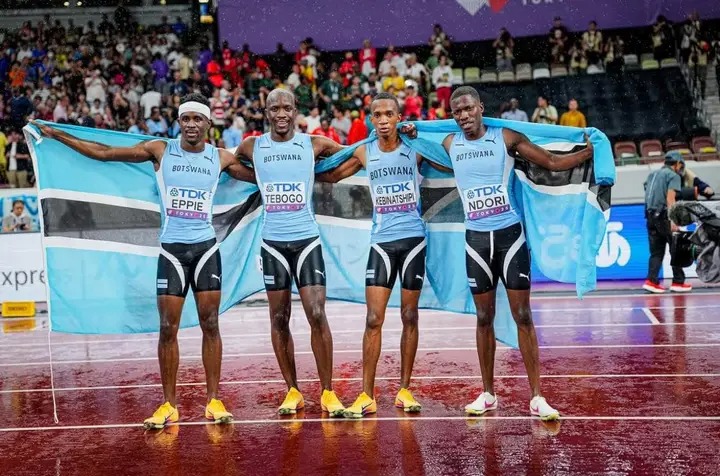
Tokyo, Japan – September 22, 2025 – In a display of raw power and unyielding determination, Botswana’s men’s 4x400m relay team etched their names into the annals of athletics history on Sunday, September 21, claiming the gold medal at the World Athletics Championships in Tokyo. Defying a relentless torrential downpour that turned the track into a slippery battlefield, the quartet from the southern African nation surged to victory in a time of 2:58.38, marking the first-ever global title for an African team in this event.
The race, held at the National Stadium in Tokyo, unfolded like a cinematic thriller, with Botswana holding off a fierce challenge from the United States and South Africa in an epic three-way finish. Anchorman Letsile Tebogo, the 22-year-old sprint sensation already hailed as Botswana’s national hero for his individual exploits, sealed the win with a blistering final leg, powering past USA’s Bryce Deadmon by a mere 0.04 seconds. South Africa’s team, featuring the dynamic Wayde van Niekerk on the anchor, took bronze just 0.10 seconds behind, while the Americans settled for silver in 2:58.42.
“This is not just a win for us; it’s a win for Africa,” Tebogo said post-race, his voice echoing the jubilation of a nation that has long punched above its weight in distance running but now conquers the sprints. The team—comprising Bayapo Ndori, Leungo Scotch, Denzel Sejoe, and Tebogo—averaged splits that showcased their depth: Ndori’s steady 45.2-second opener set the tone, Scotch maintained momentum at 44.8 seconds, Sejoe’s 45.1-second third leg kept them in contention, and Tebogo’s explosive 43.28-second anchor delivered glory.
Botswana’s triumph adds to a golden weekend for the country, as 21-year-old Collen Kebinatshipi had earlier become the nation’s first men’s individual world champion by winning the 400m in 44.12 seconds amid the same driving rain. The relay victory, however, stands as a collective milestone, breaking the dominance of traditional powers like the USA, which has claimed 18 of the previous 28 world and Olympic titles in the event.
Back home, the achievement sparked nationwide celebrations. President Duma Boko declared a public holiday on Monday, September 22, hailing the team as “heroes who have lifted Botswana to new heights.” Crowds gathered in Gaborone, waving flags and chanting “Like gods they rose,” a phrase that captured the mythic resilience displayed in Tokyo’s storm-lashed conditions.
For Botswana, a nation of just 2.4 million people, this gold represents more than medals—it’s a symbol of rising athletic prowess on the global stage. With Tebogo, who also anchored Botswana to Olympic silver in Paris 2024, leading the charge, the future looks electric. As World Athletics president Sebastian Coe noted, “Botswana’s performance redefines what’s possible in the relay arena.”
A Nation’s Jubilation and Historic Milestone
Botswana’s victory sparked euphoria across the 2.4 million-strong nation, underscoring its emergence as an athletics powerhouse. Tebogo, who anchored the team to Olympic silver in Paris 2024 after his individual 200m gold there, had endured heartbreak in Tokyo with a false start disqualification in the 100m final and a fourth-place finish in the 200m despite a 19.65-second clocking. His post-race elation was palpable as the pale blue-shirted team splashed through puddles in celebration, evoking Gene Kelly’s iconic rain dance.
President Duma Boko, addressing the nation from New York during the UN General Assembly, declared Monday, September 29—a day before Botswana’s independence celebrations—a public holiday. “This is a historic African win,” Boko proclaimed. “Botswana’s natural diamonds are not just in the ground; they are our world champion athletes.” Crowds in Gaborone erupted in chants, flags waving under clear southern skies far removed from Tokyo’s storm.
The win builds on individual bronzes and silvers from Ndori and Tebogo in the 400m and Paris relay, respectively, highlighting Botswana’s depth in a discipline long dominated by North American and European squads. As van Niekerk, nearing retirement, reflected: “These are confident guys; it’s a privilege to finish my 400m career with them.” Benjamin echoed the sentiment for the USA, which rebounded in the women’s relay later that evening, winning gold in 3:16.61 anchored by Sydney McLaughlin-Levrone: “We weren’t supposed to be here, but silver is pretty good.”
Global Impact and Championships Legacy
Fourth place went to Belgium in 2:59.48, followed by Qatar (3:01.64) and Great Britain (3:03.05). World Athletics president Sebastian Coe praised the result as a “redefinition of relay possibilities,” noting how Kebinatshipi’s strategic final 80 meters—saving energy before unleashing speed—turned the tide. “I had to run smart in the weather,” Kebinatshipi said. “I’m grateful for two golds; this one for the team.”
As the championships wrap up, Botswana’s gods-like rise from the rain-soaked track resonates worldwide, inspiring underdogs everywhere. In an era of predictable podiums, this triumph reminds us that history is forged in the storm